Students of Mendel University in Brno won an international competition in Portugal
14. 5. 2026
A team of four students from the follow-up Master’s program in Landscape Architecture at the Faculty of Horticulture of Mendel University in Brno achieved an exceptional success. With a project focused on the restoration of the Portuguese city of Guimarães, they won first place in the prestigious international competition LE:NOTRE International Student Competition 2025/2026. They presented the results of their work last week at the international professional conference LE:NOTRE Landscape Forum.
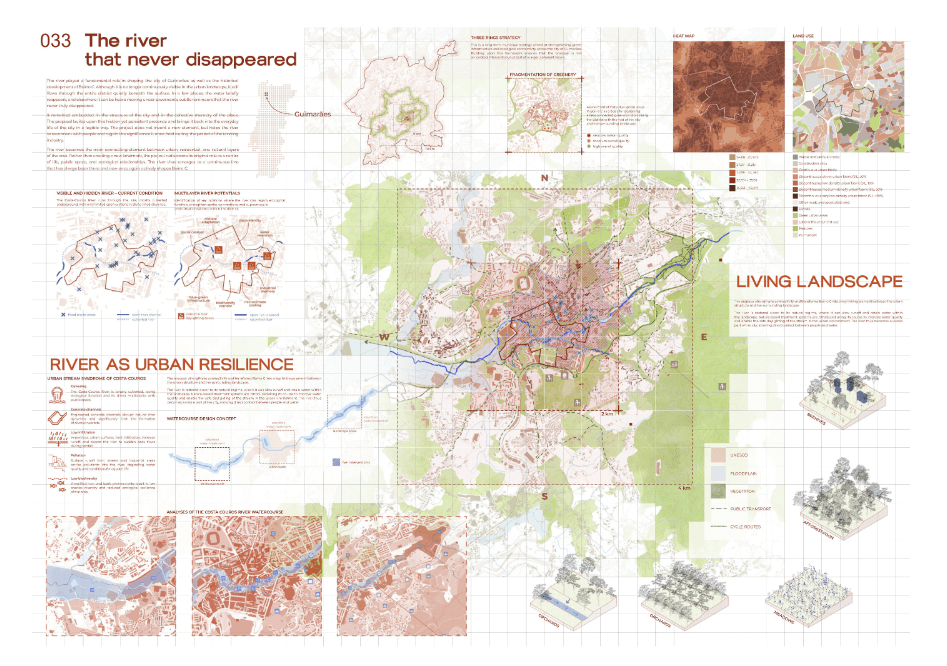
The winning project by students Klára Bábalová, Terezie Jančálková, Eliška Oherová and Veronika Čaban Tomek, titled “The River That Never Disappeared,” focuses on the revitalization of the historically significant Bairro C district. The central theme of the proposal is the Costa-Couros River, which is currently culverted and disconnected from everyday urban life throughout much of the area. Today, the site faces physical degradation, social issues, and environmental challenges. The project therefore combines ecological, social, and spatial strategies on scales ranging from the broader landscape to specific locations within the district.
The proposal activates unused areas and transforms them into orchards, flower meadows, small-scale agricultural plots, beekeeping zones, and new forested areas. Water is the project’s key theme — the Costa-Couros stream becomes the symbolic backbone of the territory. The design responds to the impacts of climate change through effective water retention in the landscape, slowing runoff, and reducing flood risks. Within the Bairro C district itself, the river is reintegrated into public space. The proposal also prioritizes walking, cycling, and public transport over car traffic and initiates the creation of high-quality public spaces connected to the river corridor. Abandoned industrial buildings are given new multifunctional uses and are naturally reintegrated into the life of the district.
An essential basis for the analytical phase of the project was a research trip to Portugal, made possible through the support of the Faculty of Horticulture at Mendel University in Brno. “The opportunity to visit the site in person was crucial for us. It helped us understand not only the physical structure of the place, but also its atmosphere, social connections, and everyday functioning. Thanks to this, we were able to design a solution that responds to the real needs of the area and its residents,” the authors of the project explained.
The competition brief encouraged participants to explore solutions to some of the most pressing challenges in contemporary urbanism. The students’ task was to consider how to connect an urban district with a vision of green infrastructure while ensuring resilience to climate change. Addressing such a demanding challenge required knowledge and application of integrative urban planning principles, which have long been developed as one of the key components of education in the Master’s degree program in Landscape Architecture at the Faculty of Horticulture of Mendel University in Brno. Their victory in the student competition confirmed that this educational approach produces results comparable on an international level.
The students’ success was preceded by intensive collaboration within the teaching activities of the Institute of Garden and Landscape Architecture at the Faculty of Horticulture of Mendel University in Brno. The students worked on the competition assignment in the Design Studio IV course under the guidance of Viktor Filipi, Adam Lacina, and Barbara Ševčíková. At the same time, all students in the year group had access to an experimental platform for theory and research within the Landscape Architecture III course. “This teaching model, referred to as Research-led Design, is based on a close connection between in-depth analytical and theoretical preparation and studio design work,” explained Barbara Ševčíková, head of the Institute of Garden and Landscape Architecture at the Faculty of Horticulture of Mendel University in Brno.
The main organizer of the competition, LE:NOTRE Institute, operates under the auspices of the European Council of Landscape Architecture Schools. The specific mission of the LE:NOTRE Institute is to connect academia with professional practice and encourage students from around the world to seek comprehensive solutions to real environmental and social challenges.
Contact for further information: Assoc. Prof. Ing. Barbara Ševčíková, Ph.D., +420 777 540 625, barbara.sevcikova@mendelu.cz, Institute of Garden and Landscape Architecture, Faculty of Horticulture, Mendel University in Brno
We work with cookies. Why? We analyse traffic and events on the website so that we can continually improve it. We also need cookies to provide social media features and to customise the content of ads. With consent, we may also pass some personal information to marketing platforms for marketing purposes.
About Cookies
Cookies are small text files in which websites can store information about your activity on the website and user preferences. They are used, for example, to make the browser remember your login, the consent settings in the cookie bar and, with your consent, various marketing and analytical information.
Necessary
These cookies ensure the basic technical functionality of the website, are necessary for the proper functioning of this website and are always active.
Analytical
We use third-party tools to track traffic. According to Google Analytics settings, personal data may also be sent.
Preferential
They store your personal settings, such as the language in which information is displayed, or allow you to offer content tailored to your needs.
Marketing
We are using third-part marketing cookies and your personal data to show you content customized to what you have viewed on our website. The content can be viewed elsewhere on the Internet. You can disagree with using of our marketing cookies but it will not reduce the extent of advertising offers you see, you will only see more of uninteresting and irrelevant ad to you.