Scientists from the Faculty of AgriSciences collaborate on the development of a drug against nerve poisoning, the antidote could help the army
13. 1. 2025
Scientists from the Faculty of AgriSciences at Mendel University in Brno are working together to develop innovative drugs against chemicals that threaten the nervous system. Together with the Faculty of Science at the University of Hradec Králové and the University of Defence, they are looking for a way to get the drugs to the brain, where they act as antidotes to organophosphate poisoning. The aim of the scientists from the Institute of Chemistry and Biochemistry is to create a transport system for the drugs.
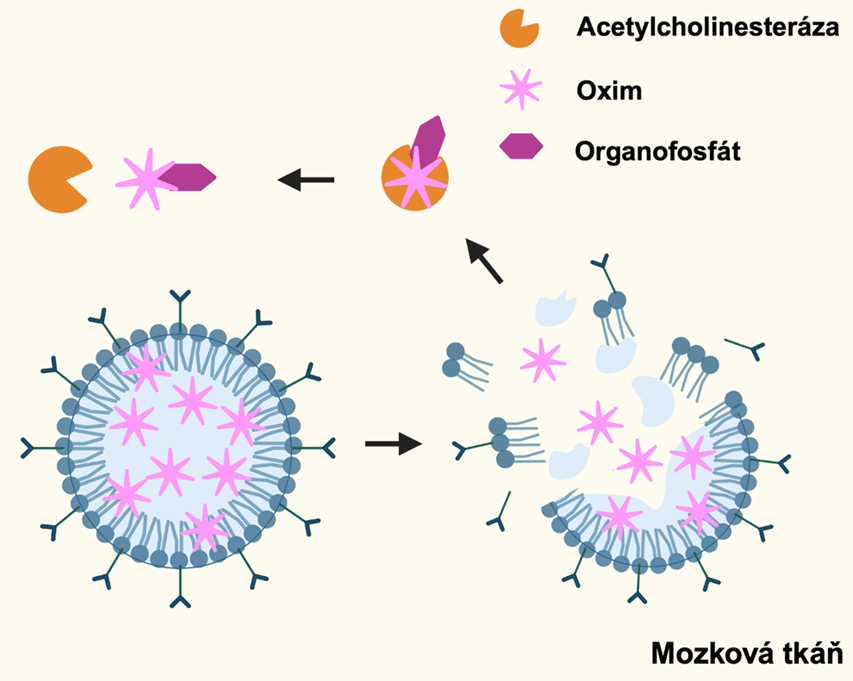
In developing countries they are found as pesticides, in wars they have been misused in the form of chemical weapons such as sarin or the compound VX. We are talking about organic phosphorus compounds, the so-called organophosphates, which cause nerve poisoning. “Organophosphates are able to act as inhibitors of acetylcholinesterase, which is an enzyme that breaks down the neurotransmitter acetylcholine and thus terminates nerve transmission. Organophosphates bind to this enzyme and inhibit its activity, resulting in continuous neuromuscular paralysis,” explained Zbyněk Heger, head of the Institute of Chemistry and Biochemistry at Mendel University in Brno.
For example, atropine or acetylcholinesterase reactivators (so-called oximes) are currently used to treat organophosphate nerve poisoning. These agents act as antidotes, but their use is still not very effective. “Atropine is a relatively toxic alkaloid. The problem with oximes, on the other hand, is that they do not penetrate the central nervous system very well. The antidote has to pass through the bloodstream, through the filtration system of the liver, kidneys and other organs, and ideally into the brain. The brain is then physiologically protected by several membranes, so the antidotes still have to pass through the blood-brain barrier,” the scientist explained how difficult it is to get the drug to the brain parenchyma. It is there that it can restore the function of enzymes disrupted by organophosphates. At present, however, only a low unit percentage of these antidotes can reach the brain by intravenous injection.
An innovative solution for the transport of oxime in the body may be so-called solid core lipid particles (SLNs). These allow the drug to be encapsulated (‘encapsulated’) and transported to the site of poisoning. “SLNs can be thought of as ~120 nanometer spheres whose surface is composed of phospholipids with a cavity composed of a solid, stabilized lipid core that allows efficient encapsulation of oxime antidotes and other lipophilic agents,” Heger described the technology his team is working on. It is the nano-formulation of SLNs that may hold the key to successfully transporting the drug in the necessary quantities in the human body to the brain.
Zbyněk Heger’s team is also working on the development with other partners, including the Faculty of Science at the University of Hradec Králové and the University of Defence. “We and our partners are particularly interested in antidotes for those who might be exposed to sarin or other nerve agents or pesticides in agriculture. For these purposes, it is necessary to have a stable antidote ready that can be applied ideally immediately after the poisoning, minutes, hours at most, as the antidote is no longer effective after a longer period of time,” Heger added. However, he said the research could have much greater biomedical implications. In the future, for example, for more effective treatment of brain tumours or dementia.
Contact for further information: mgr. Mgr. Zbyněk Heger, PhD., +420 723 429 496, zbynek.heger@mendelu.cz, Department of Chemistry and Biochemistry, MENDELU University of Applied Sciences
Photo: SLNs with encapsulated oxime (green) in cells.
We work with cookies. Why? We analyse traffic and events on the website so that we can continually improve it. We also need cookies to provide social media features and to customise the content of ads. With consent, we may also pass some personal information to marketing platforms for marketing purposes.
About Cookies
Cookies are small text files in which websites can store information about your activity on the website and user preferences. They are used, for example, to make the browser remember your login, the consent settings in the cookie bar and, with your consent, various marketing and analytical information.
Necessary
These cookies ensure the basic technical functionality of the website, are necessary for the proper functioning of this website and are always active.
Analytical
We use third-party tools to track traffic. According to Google Analytics settings, personal data may also be sent.
Preferential
They store your personal settings, such as the language in which information is displayed, or allow you to offer content tailored to your needs.
Marketing
We are using third-part marketing cookies and your personal data to show you content customized to what you have viewed on our website. The content can be viewed elsewhere on the Internet. You can disagree with using of our marketing cookies but it will not reduce the extent of advertising offers you see, you will only see more of uninteresting and irrelevant ad to you.