Czech Peas Under the Microscope: Researchers at MENDELU Are Fighting Diseases That Threaten Food Security
20. 7. 2026
The common pea is one of the key crops in European agriculture, particularly due to its ability to fix atmospheric nitrogen and produce high-quality plant protein. However, its cultivation has faced a serious threat in recent years in the form of root rot, which significantly reduces yields. A research team from Mendel University in Brno has therefore been investigating, since the beginning of this year, the possibilities of developing new pea genotypes resistant to root rot.
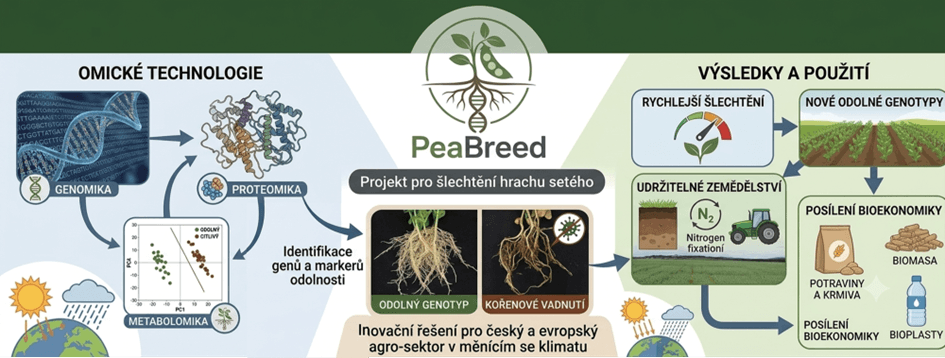
New research by PeaBreed aims to lay the genetic foundation for breeding new, more resilient pea varieties. “Our goal is not just laboratory analysis, but to directly help farmers. We want to identify specific genes and resistance markers that will enable breeders to accelerate the development of varieties better equipped to withstand climate change and challenges such as root rot,” said Martin Černý, project coordinator at the Institute of Molecular Biology and Radiobiology at MENDELU’s Faculty of AgriSciences.
Through the targeted breeding of new pea varieties, the research team is helping to ensure food self-sufficiency, as root rot can cause significant crop losses. Furthermore, peas are not only a crop for food and feed but also represent a promising raw material for the production of biomass and bioplastics, which strengthens the competitiveness of the Czech agricultural sector.
To accurately identify resistant genotypes, the research team uses state-of-the-art omics approaches, including genomics, proteomics, and metabolomics. These methods allow the team to closely monitor how pea plants respond to pathogens that cause root wilt. Identifying genes associated with resistance to wilt will then facilitate the selection of suitable lines for further breeding.
“The PeaBreed project serves as a key bridge between basic research and practical agriculture, offering innovative solutions for sustainable farming under changing climatic conditions,” added Černý. For Mendel University in Brno, research on this crop also holds symbolic significance. The university, which proudly bears the name of the founder of genetics, is thus building on his historical legacy through this new project. The research team consists of experts in plant biotechnology, molecular biology, omics analyses, bioinformatics, and legume breeding, who work closely together to effectively translate scientific knowledge into breeding practice.
The five-year research project, titled PeaBreed: Development of Root Wilt-Resistant Pea Genotypes Using Omics Approaches, is supported by the Czech Ministry of Agriculture under the ZEMĚ II program and brings together leading expertise from MENDELU, Agritec, the National Center for Agricultural and Food Research, Palacký University in Olomouc, and SELGEN, a.s.
We work with cookies. Why? We analyse traffic and events on the website so that we can continually improve it. We also need cookies to provide social media features and to customise the content of ads. With consent, we may also pass some personal information to marketing platforms for marketing purposes.
About Cookies
Cookies are small text files in which websites can store information about your activity on the website and user preferences. They are used, for example, to make the browser remember your login, the consent settings in the cookie bar and, with your consent, various marketing and analytical information.
Necessary
These cookies ensure the basic technical functionality of the website, are necessary for the proper functioning of this website and are always active.
Analytical
We use third-party tools to track traffic. According to Google Analytics settings, personal data may also be sent.
Preferential
They store your personal settings, such as the language in which information is displayed, or allow you to offer content tailored to your needs.
Marketing
We are using third-part marketing cookies and your personal data to show you content customized to what you have viewed on our website. The content can be viewed elsewhere on the Internet. You can disagree with using of our marketing cookies but it will not reduce the extent of advertising offers you see, you will only see more of uninteresting and irrelevant ad to you.