MENDELU research team explores alternative ways of growing malting barley
15. 5. 2025
The scientific team of the Faculty of AgriSciences at MENDELU in cooperation with Plzeňský Prazdroj, the agricultural company JTZE a.s. and the Czech University of Agriculture is investigating alternative methods of growing malting barley in the Czech Republic adapted to the conditions of climate change. In the framework of the research project "For Barley", scientists are testing a regenerative cultivation method with the inclusion of intercrops and reduced tillage. They are monitoring the impact of these measures on changes in soil properties, yield and grain quality.
Climate change has made it increasingly difficult to achieve the required grain quality when growing malting barley in the Czech Republic in the traditional way. However, barley as a raw material is essential for breweries, which is why the scientific team of the Faculty of AgriSciences at MENDELU is involved in research on regenerative barley cultivation practices that use intercropping in the intercropping period while minimising soil tillage. “Malting barley is an essential raw material for Plzeňský Prazdroj. The brewery is committed to the Czech origin of barley and domestic production of malt, where the quality of production can be better controlled,” said Jakub Zaoral, sustainability manager at Plzeňský Prazdroj a.s., which is coordinating the research project.
The research focusing on the comparison of conventional and regenerative field crop cultivation is being carried out from 2023 on three sites in the Czech Republic with a total area of over 200 hectares. The experimental sites near Jihlava and Hradec Králové are located on land managed by the agricultural company JTZE a.s., while the experiments at the third site are being conducted by the Czech University of Agriculture on its farm near Prague. “The essential features of the regenerative farming variant are the limitation of soil cultivation, leaving post-harvest residues on the soil surface and the inclusion of species-rich intercrops in the crop rotation,” explained Jakub Elbl from JTZE a.s. Intercrops prevent weed growth, retain moisture in the soil, nourish and protect it. “Currently, rainfall is very intense and sudden, and if there is no or minimal cover on the soil, the soil erodes and erodes the top layer, which is quite a demanding process for the soil. Vegetation cover minimises these risks. Regenerative farming ideally tends to keep the soil in the field covered with vegetation all year round,” said Kateřina Kuchaříková, a PhD student at the Institute of Agrosystems and Bioclimatology involved in the research.
In comparing conventional and regenerative cultivation, scientists monitor a number of soil, plant and yield parameters. Traditional practices are complemented by the latest ‘smart farming’ technologies. These include smart meteorological sensors that record the weather conditions at selected experimental sites or methods that allow for whole-crop mapping. These include in particular remote monitoring using Sentinel-2 and PlanetScope satellites to capture the development of crop stands in several days’ time and unmanned drone imagery that provides very accurate data on plant condition, crop damage or weed infestation in a few deadlines. The list is extended by advanced technologies for guiding machinery during individual operations on plots with a few centimetres of accuracy using GNSS-RTK and the collection of records from harvesting equipment, which provide valuable information on crop yields achieved in individual plots. “Validation of the use of precision farming methods is part of the project’s solution to offer agricultural practice sufficient tools for early detection of problems, improved diagnosis of plant conditions and obtaining the basis for designing targeted interventions,” described Vojtěch Lukas from the Institute of Agrosystems and Bioclimatology, head of the research team at MENDELU.
The diversity of soil and climatic conditions, management practices and stand establishment are reflected in the differences in results between sites. “Barley grain yield and quality parameters were equal or lower by only one per cent in the regenerative variant at two sites in the first year of full implementation of regenerative cultivation practices. However, the third site showed a significant drop due to vole damage, which can be a major problem in regenerative farming,” said Lukas. This is not the only challenge that will need to be addressed. It also includes the need to terminate intercropping in the spring with a mild winter, issues of controlling fouling with reduced tillage, or the choice of appropriate mechanisation to establish stands and ensure uniform emergence of plants.
The research project is scheduled to run until 2027. A multi-year iteration is necessary to ensure telling results. Thus, the MENDELU research team and project partners will continue the experimental activities in 2025 to ensure sufficient results for statistical evaluation of the newly proposed regenerative cultivation method and possible demonstration of benefits in terms of soil quality, production and grain quality parameters, as well as assessment of the economics of cultivation. PhD students of the Institute of Agrosystems and Bioclimatology are involved in field measurements, spatial data processing and evaluation of the experimental results. The results of the experimental activities are also the subject of student theses currently being solved at MENDELU.
Contact for further information: doc. Ing. Vojtěch Lukas, Ph.D., Department of Agrosystems and Bioclimatology, MENDELU, vojtech.lukas@mendelu.cz, +420 605 835 253; Ing. Kateřina Kuchaříková, Department of Agrosystems and Bioclimatology, MENDELU, katerina.kucharikova@mendelu.cz
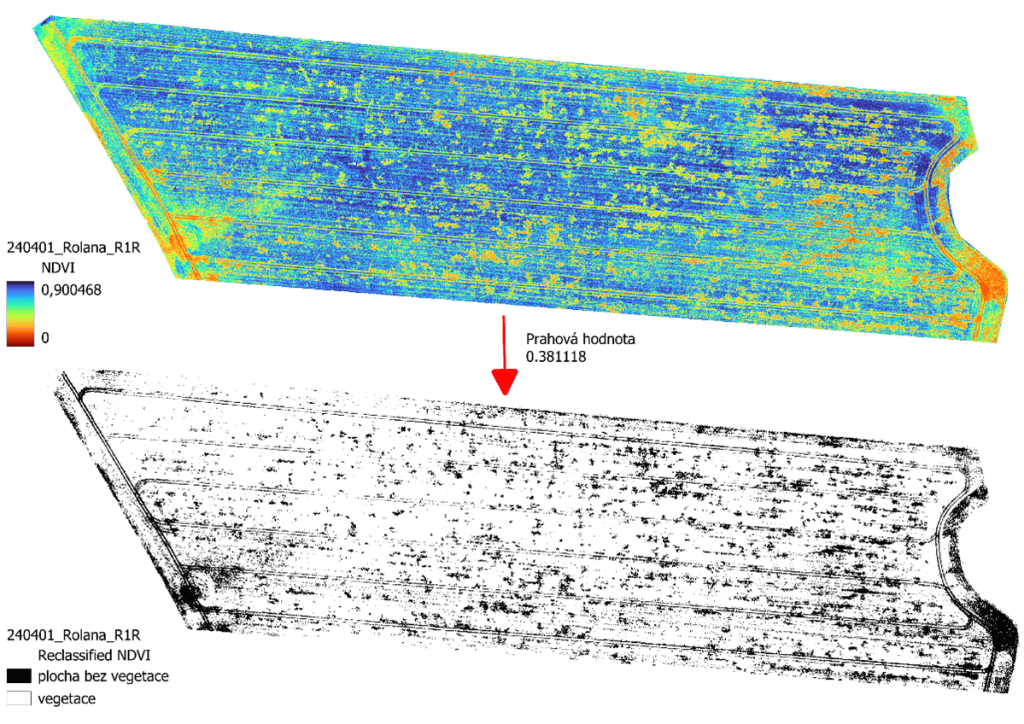
Use of drone imagery for detailed mapping of vegetation damage
We work with cookies. Why? We analyse traffic and events on the website so that we can continually improve it. We also need cookies to provide social media features and to customise the content of ads. With consent, we may also pass some personal information to marketing platforms for marketing purposes.
About Cookies
Cookies are small text files in which websites can store information about your activity on the website and user preferences. They are used, for example, to make the browser remember your login, the consent settings in the cookie bar and, with your consent, various marketing and analytical information.
Necessary
These cookies ensure the basic technical functionality of the website, are necessary for the proper functioning of this website and are always active.
Analytical
We use third-party tools to track traffic. According to Google Analytics settings, personal data may also be sent.
Preferential
They store your personal settings, such as the language in which information is displayed, or allow you to offer content tailored to your needs.
Marketing
We are using third-part marketing cookies and your personal data to show you content customized to what you have viewed on our website. The content can be viewed elsewhere on the Internet. You can disagree with using of our marketing cookies but it will not reduce the extent of advertising offers you see, you will only see more of uninteresting and irrelevant ad to you.